AI Agent vs. Chatbot: What’s the Real Difference?
If you are searching for AI agent vs. chatbot, you are probably seeing the same two terms used almost interchangeably. Both can talk to users in natural language, both may use large language models, and both can look “smart” from the outside. But they are not the same kind of product.
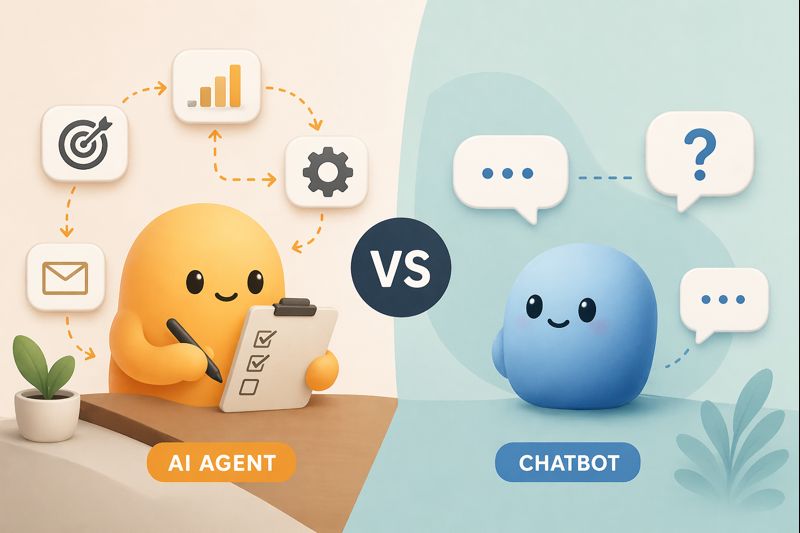
The simplest distinction is this: a chatbot is mainly designed to reply, while an AI agent is designed to pursue a goal, use tools, and keep working across steps. Once you understand that difference, it becomes much easier to decide what to use, what to ignore, and whether you need one system or both.
What Is a Chatbot?
A chatbot is a conversational interface built to answer questions, guide users through a flow, or handle repetitive interactions. In most cases, the conversation itself is the product. A chatbot may help a visitor find documentation, book a demo, check an order status, or get a quick answer without waiting for a human.
That is why chatbots still make sense for many business use cases. If the job is to reduce support volume, qualify leads, or handle a narrow set of predictable requests, a chatbot is often the cleanest solution. It is faster to deploy, easier to control, and usually less expensive than building something more autonomous.
You can see this clearly in current products. These tools are useful, but their strength is not broad autonomous execution. Their strength is structured conversation.
HubSpot Chatbot Builder
 HubSpot Chatbot Builder is a good example of a classic business chatbot. It is built for lead capture, simple support routing, meeting booking, and predictable website conversations. If your goal is to guide a visitor through a clear flow, this kind of chatbot usually makes more sense than a full AI agent.
ManyChat
 ManyChat is strongest in messaging-first environments such as Instagram, WhatsApp, and similar channels. It works well when the business needs fast replies, light automation, and repeatable engagement patterns rather than deeper multi-step execution behind the scenes.
MyClaw
 MyClaw is not best understood as a pure chatbot product, but it is still relevant here because many users first meet AI through a conversational interface. If someone wants a chat-based assistant experience with more room to grow into persistent workflows later, MyClaw can sit near the edge of the chatbot category while clearly going beyond it.
Modern chatbots may sound much more natural than older rule-based bots, but that does not automatically make them AI agents. Better language does not change the category if the system is still mostly there to answer and route.
What Is an AI Agent?
An AI agent is software that can work toward a goal over multiple steps instead of stopping at a single reply. It may reason through a task, decide what to do next, use tools, retrieve information, interact with apps, and continue until it reaches a useful outcome. In practice, that means the agent is closer to an execution layer than a chat layer.
This is where the category shift becomes real. A user might ask an agent to research a company, update a CRM, summarize the findings, and draft a follow-up. Or the task could involve checking several tools, monitoring a workflow, or taking browser-based actions. The value is not just that the system can talk. It can act.
Current products make that distinction easier to see.
ChatGPT Agent
 ChatGPT agent is increasingly positioned around research, task execution, and web-based actions. It helps illustrate the jump from “answering a question” to “doing a job,” especially when the task involves several steps instead of one response.
Lindy
 Lindy is a clearer business-workflow example of the agent category. It is designed to connect with other tools, move tasks across systems, and keep operational processes running with less manual follow-up.
MyClaw
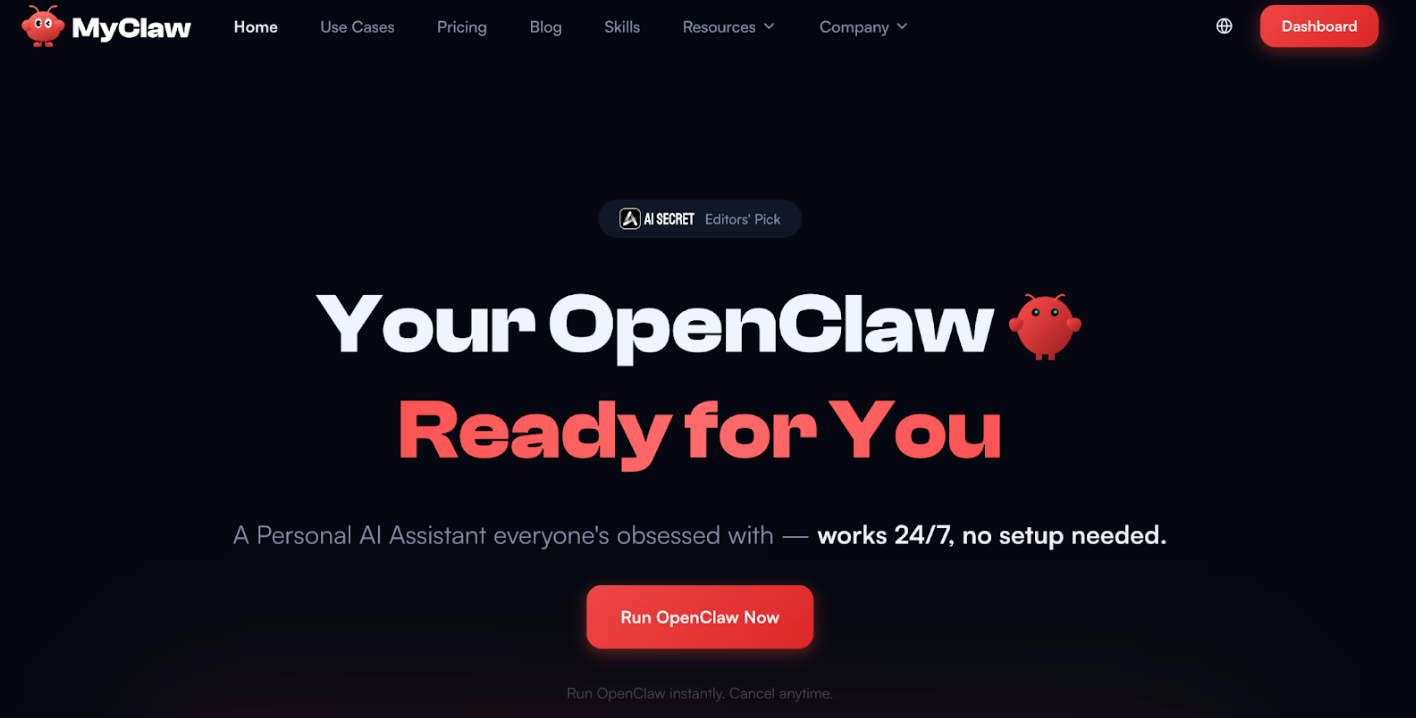 MyClaw fits the AI agent category more directly because it is useful for people who want a private, always-on OpenClaw-based assistant without self-hosting the full stack themselves. It is a stronger fit when the user wants persistence, tool access, and an agent that stays available beyond one chat session. If you want a broader market view of this category, best AI agents is a useful comparison point.
That is the practical answer to agentic AI vs. chatbot: agentic AI is not just better conversation. It is goal-oriented software with more room to plan, act, and persist.
AI Agent vs. Chatbot: 5 Real Differences
1. Response vs. Action
A chatbot mainly responds to prompts. It gives an answer, offers options, or hands the case to a human. An AI agent can go further by taking action after the answer. That might mean opening a tool, updating data, running a workflow, or completing part of the task on the user’s behalf.
2. Single-Turn Help vs. Multi-Step Work
 Most chatbots are optimized for short conversations. Even if they can maintain context for a while, the workflow is still basically turn-by-turn. An AI agent is more useful when the task itself has several stages. It can break the job into smaller steps and continue without needing the user to manually drive every move.
3. Limited Context vs. Working Memory
Chatbots often rely on the current conversation, a help center, or a predefined flow. AI agents are more valuable when they can keep track of state, remember earlier work, or revisit context from a prior step. That does not mean every agent has perfect memory, but persistence is much more central to the category.
4. Simple Integrations vs. Tool Use
A chatbot may connect to a FAQ database, a support platform, or a scheduling form. An AI agent is usually defined by deeper tool use. It may browse the web, read files, trigger APIs, or coordinate across several systems. If you want a more concrete sense of how that capability expands in practice, best openclaw skills is a good example of the “tool layer” that makes agents meaningfully different from plain chat.
5. Lower Complexity vs. Higher Leverage
Chatbots are easier to launch because the scope is narrower. AI agents can deliver more leverage, but they also introduce more complexity around permissions, reliability, and monitoring. That is one reason the operational side matters so much once agents move beyond demos. The security side matters too, especially when an agent can access sensitive systems or trigger actions, which is why ai agent security becomes part of the conversation much earlier than it does for most basic chatbots.
When a Chatbot Is Enough
A chatbot is often the right answer when conversation is the end product. If you mainly need to answer repetitive questions, qualify inbound leads, route support requests, or guide users through a straightforward decision tree, an agent may be more than you need.
 This is especially true for customer-facing environments where consistency matters more than autonomy. A support team may prefer a chatbot that stays inside a controlled knowledge boundary. A marketing team may just want a bot that captures email addresses and books meetings. A creator or ecommerce brand may only need messaging automation across social channels. In those cases, products like HubSpot Chatbot Builder, ManyChat, or Quickchat AI make sense precisely because they are narrower.
The mistake is assuming every conversational interface should become an agent. If the task is predictable and the value comes from speed, control, and lower maintenance, a chatbot can be the stronger product decision.
4 Signs You Need an AI Agent Instead of a Chatbot
An AI agent becomes more useful when the real job starts after the reply. If the workflow requires tool access, cross-app coordination, persistent context, or action over several steps, a chatbot usually starts to feel too shallow.
Common examples include researching leads and updating a CRM, monitoring a process and triggering follow-up actions, handling browser-based work, organizing information across files and apps, or managing recurring tasks that do not fit into one message-response cycle.
You Need Tool Access
Once the system needs to open apps, call APIs, browse the web, or work across files, you are moving beyond basic chatbot behavior. The key difference is no longer language quality. It is the ability to use external tools to complete work.
You Need Multi-Step Execution
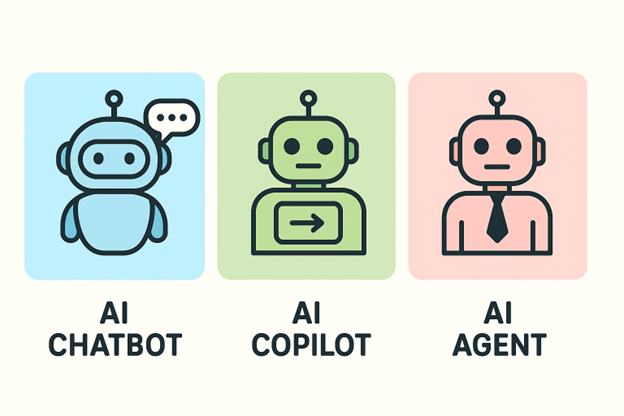 If the task requires planning and follow-through, a chatbot often becomes too shallow. An AI agent can break a request into steps, carry context from one stage to the next, and continue toward an outcome instead of waiting for manual instructions after every reply.
You Need Persistent Context
Some workflows only become useful when the system can stay available over time. That matters for recurring tasks, long-running processes, and work that depends on remembering previous context instead of restarting from zero every session.
You Need a More Operational Product
That is also why coding-oriented agent products feel different from chatbot products. Once a system is reading a repo, using terminal tools, and working through a multi-step task, you are firmly in agent territory.
There is also a practical infrastructure point here. As soon as the agent is supposed to stay available and keep context over time, deployment becomes part of the product decision. That is where managed paths become more attractive than building everything from scratch. Readers thinking through that tradeoff may also want best openclaw hosting.
Do You Need a Chatbot or an AI Agent or Both?
In many cases, the best answer is not one or the other. Teams often use both, because they solve different layers of the same workflow.
A chatbot can handle the front door by answering routine questions, collecting user intent, and covering high-volume conversations that need consistency. Behind that layer, an AI agent can handle the more complex work that requires reasoning, tool use, and follow-through.
Use a Chatbot for the Front Door
The chatbot layer is useful when the main need is intake, triage, and fast response. It is good at handling repetitive conversations, capturing user intent, and creating a consistent first interaction.
If you want a sharper example of how execution-focused agents differ from chat-style assistants in technical work, hermes agent vs. claude code is a useful companion read.
Use an AI Agent for the Back-End Work
The agent layer becomes useful after the request is understood. This is where the system can research the issue, check internal tools, prepare the next action, or push work into another workflow without stopping at the conversation itself.
Use Both When the Workflow Has Two Layers
For many teams, this is the most practical setup. The chatbot gathers the request, and the AI agent handles the higher-value execution behind the scenes. That approach is often more realistic than trying to force one category to do everything equally well.
This is also the most honest way to think about AI agents vs. chatbots. A chatbot does not become obsolete just because agents are improving. The better question is where conversation should stop and where execution should begin. If your users mostly need answers, start with a chatbot. If your team needs software that can keep going after the answer, move toward an agent. If you need both layers, design for both instead of trying to force one category to do everything.
Conclusion
The real AI agent vs. chatbot difference is not that one is “newer” or more hyped. It is that they are built for different jobs. Chatbots are strongest when the goal is structured, repeatable conversation. AI agents are stronger when the goal involves decisions, tool use, persistence, and action across multiple steps.
That is why products like HubSpot Chatbot Builder, ManyChat, and Quickchat AI make sense in one category, while ChatGPT agent, Lindy, and MyClaw fit another. The right choice depends less on how advanced the interface looks and more on what must happen after the first reply. If the conversation is the work, use a chatbot. If the conversation is only the starting point, you are probably looking for an AI agent.
Skip the setup. Get OpenClaw running now.
MyClaw gives you a fully managed OpenClaw (Clawdbot) instance — always online, zero DevOps. Plans from $19/mo.