Hermes Agent vs. Claude Code: Which AI Agent Fits Your Workflow?
Hermes Agent vs. Claude Code: Which AI Agent Fits Your Workflow?
People searching hermes agent vs. claude code usually want a practical answer, not another vague AI-agent essay. Claude Code is a coding-first agent built around repositories, IDEs, git, and software delivery. Hermes Agent is broader: a more persistent, cross-session, cross-surface agent that can keep context and run beyond a single coding session.
The decision is less about which one is smarter and more about what kind of work you want the agent to own.
Hermes Agent vs. Claude Code: Quick Answer
- Choose Claude Code if your work is mostly inside repos and your priority is writing, reviewing, debugging, and shipping code faster.
- Choose Hermes Agent if you want stronger long-term continuity, more flexibility around models and deployment, and an agent that can live beyond the editor.
- Choose both if you want the best coding workflow and a separate automation layer. If Claude Code is still your benchmark for coding-first tools, Codex vs. Claude Code is a useful companion comparison.
Hermes Agent vs. Claude Code Comparison Table
| Category | Hermes Agent | Claude Code |
|---|---|---|
| Best for | Persistent automation and cross-session agent workflows | Coding-first work in repos and IDEs |
| Core strength | Memory, autonomy, and broader agent runtime | Code reasoning, implementation, and developer workflow |
| Memory style | Built around persistent memory, skills, and continuity | Uses project instructions plus auto memory, but remains more repo-centered |
| Model flexibility | Broad provider choice and self-hosted flexibility | Anthropic-centered experience |
| Interfaces | CLI, messaging platforms, remote runtimes, API-style setups | Terminal, web, desktop, VS Code, JetBrains, CI |
| Scheduling | Strong fit for recurring and always-on workflows | Supports routines and scheduled tasks, but still feels coding-centric |
| IDE fit | Good, but not the native center of gravity | Excellent |
| Git and PR workflow | Usable, but not the main differentiator | Strong, polished, and direct |
| Setup burden | More configurable, often more involved | Faster to value for pure developers |
| Best fit | Builders who want a durable agent system | Developers who want a highly effective coding agent |
What Hermes Agent Does Better
Persistent Memory Across Sessions
This is the clearest reason to choose Hermes Agent. Claude Code has project instructions, hooks, MCP, and auto memory, but Hermes is built more explicitly around accumulating useful context across repeated interactions. If you want an assistant that gets better at your workflows over time, Hermes usually feels more natural.
Automation Beyond the Code Editor
Hermes Agent also makes more sense when the work is not primarily "open a repo and change code." It is stronger for recurring workflows, scheduled jobs, messaging-driven tasks, and broader agent behavior outside an IDE. If your bigger question is how to extend an agent once it is running, Best OpenClaw Skills for Different Purposes in 2026 is one of the more useful follow-up reads.
Model Flexibility and Self-Hosted Control
Hermes Agent is also more attractive if you care about infrastructure and provider choice. It fits better into a customizable agent stack and gives you more room to self-host, switch providers, or shape the runtime around your own operating model. If that tradeoff pushes you toward deployment questions, Best OpenClaw Hosting in 2026 is a relevant next step.
What Claude Code Does Better
Coding Depth and Codebase Reasoning

Claude Code is the stronger choice if the heart of your workflow is software engineering. Its product surface is built for reading code, modifying multiple files, debugging, refactoring, running checks, and moving from request to implementation with minimal friction. Its specialization is exactly why it feels strong.
Better Native Developer Workflow
Claude Code also has the better native developer experience. It works naturally in the terminal, integrates with VS Code and JetBrains, supports git-heavy workflows, and connects to external tools through MCP. If your daily loop includes tickets, branches, diffs, tests, and PRs, Claude Code usually gets to value faster.
Faster Time to Value for Pure Developers
If the goal is simply "help me ship code faster this week," Claude Code is often the easier recommendation. You open the project, give it work, review the output, and move forward.
Hermes Agent vs. Claude Code: The Real Tradeoffs
Coding Specialist vs. General Agent
This is the real decision. Claude Code is a specialist with expanding general capabilities. Hermes Agent is a broader agent system that can include coding but is not defined by it. If you judge both only by coding output, Claude Code will usually look stronger. If you judge both by continuity and non-IDE automation, Hermes looks more attractive.
Session Intelligence vs. Compounding Memory
Claude Code is excellent at focused work in a project context. Hermes is more compelling when the value compounds across sessions. If the assistant mostly helps you finish today's coding task, Claude Code fits. If it should become more useful as it lives with your workflows, Hermes has the better story.
Local Coding Flow vs. Always-On Runtime
Claude Code can absolutely automate real work, including scheduled and remote workflows, but it still feels centered on development work. Hermes feels more like an always-on runtime that can be placed where you need it and interacted with across time and channels.
Setup, Cost, and Maintenance
Setup and Learning Curve
Claude Code is usually easier to recommend when you want fast adoption inside an existing development workflow. Hermes Agent often asks for more thinking up front because its flexibility creates more decisions around models, runtime, interfaces, and operating style.
Real Cost Over Time

Real cost is not only subscription or token pricing. It is also maintenance cost, update overhead, and the time you spend keeping the system stable. Claude Code can be more expensive if you use it heavily, but it saves time because the workflow is tight. Hermes can be more cost-flexible, but you may own more maintenance work.
Security and Permission Style
Both tools take security and permissions seriously, but they frame them differently. Claude Code emphasizes approvals and controlled execution inside developer environments. Hermes Agent puts more emphasis on runtime control and deployment choice. If this part of the decision matters most to you, AI Agent Security in 2026 is the best adjacent read.
Who Should Choose Hermes Agent?
Hermes Agent is the better fit if you want:
- stronger cross-session memory
- broader automation outside coding
- more control over models and infrastructure
- an agent that can stay useful across repeated workflows over time
Who Should Choose Claude Code?
Claude Code is the better fit if you want:
- a coding-first agent
- stronger developer workflow inside repos and IDEs
- less interest in building a wider automation runtime
- a faster path to value for debugging, refactoring, reviews, and implementation work
When Using Both Makes More Sense
Many advanced users should not force a winner here. The more practical setup is often to split responsibilities:
- Claude Code for code-heavy work
- Hermes Agent for recurring workflows, memory-heavy processes, or broader automation
This maps well to how the products are designed. Claude Code handles the high-focus repo work. Hermes handles the continuity and wider agent behavior beyond the repo. If you want to see how Hermes compares with a more automation-native alternative, Hermes Agent vs. OpenClaw adds useful context.
When MyClaw.ai Is the Better Fit
Some readers searching hermes agent vs. claude code are actually trying to solve a different problem. They do not want the best coding agent, and they do not want to build a flexible self-hosted agent stack either. They want an always-on assistant without deployment friction.
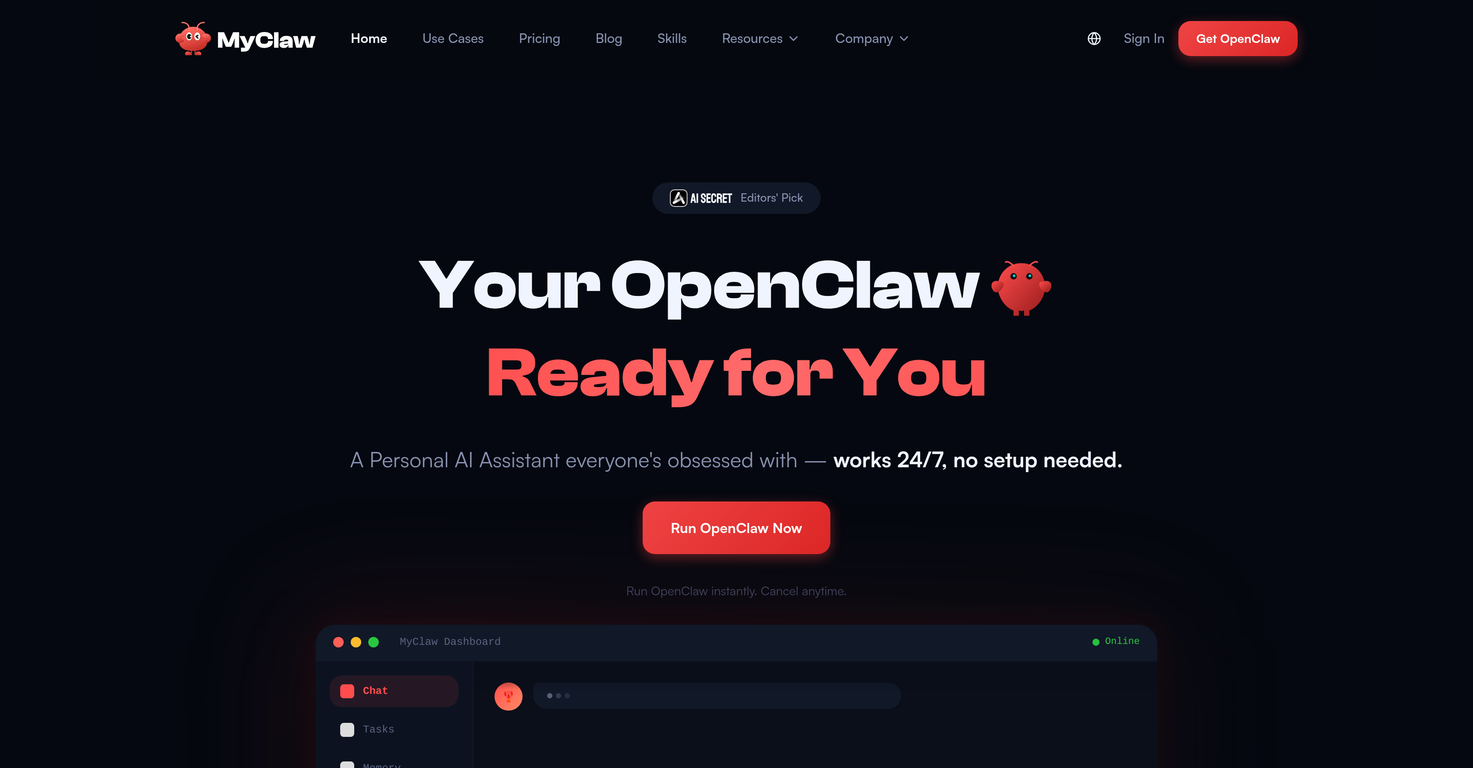
That is where MyClaw.ai fits more naturally. It is not a replacement for Claude Code if your primary job is software engineering. It is the more practical option for people who care most about getting an always-on assistant running without taking on self-hosting overhead.
MyClaw.ai makes the most sense for:
- users who want OpenClaw-style always-on assistance
- teams that do not want to self-host or maintain the environment
- buyers who care more about automation convenience than building a custom agent stack
The best fit is usually founders, solo operators, non-technical buyers, and small teams that want automation outcomes without DevOps work. If Claude Code feels too coding-specific and Hermes feels too setup-heavy, MyClaw.ai is the simpler route.
FAQ
Is Hermes Agent better than Claude Code?
Not universally. Hermes Agent is better for persistent memory, broader automation, deployment flexibility, and long-term continuity. Claude Code is better for coding-first workflows, repo work, and day-to-day developer execution.
Can Hermes Agent replace Claude Code for coding?
Partially, yes. But if coding is the core job, Claude Code will usually still be the stronger primary tool because the product is so tightly aligned with software engineering workflows.
Is Claude Code only for developers?
No. Claude Code now reaches beyond a simple terminal coding assistant through web access, MCP integrations, schedules, remote control, and broader automation patterns. But it is still best understood as a coding-first product.
Conclusion
The hermes agent vs. claude code decision becomes much simpler once you stop treating both tools as interchangeable AI agents. Claude Code is the stronger choice when your priority is coding speed, repo workflow, debugging, implementation, and developer productivity. Hermes Agent is the stronger choice when your priority is persistent memory, broader automation, model and runtime flexibility, and a more durable agent system.
If you need both coding depth and a wider automation layer, using both can be the smartest setup. If what you actually want is an always-on assistant without the self-hosting burden, MyClaw.ai is the more practical path.
Skip the setup. Get OpenClaw running now.
MyClaw gives you a fully managed OpenClaw (Clawdbot) instance — always online, zero DevOps. Plans from $19/mo.