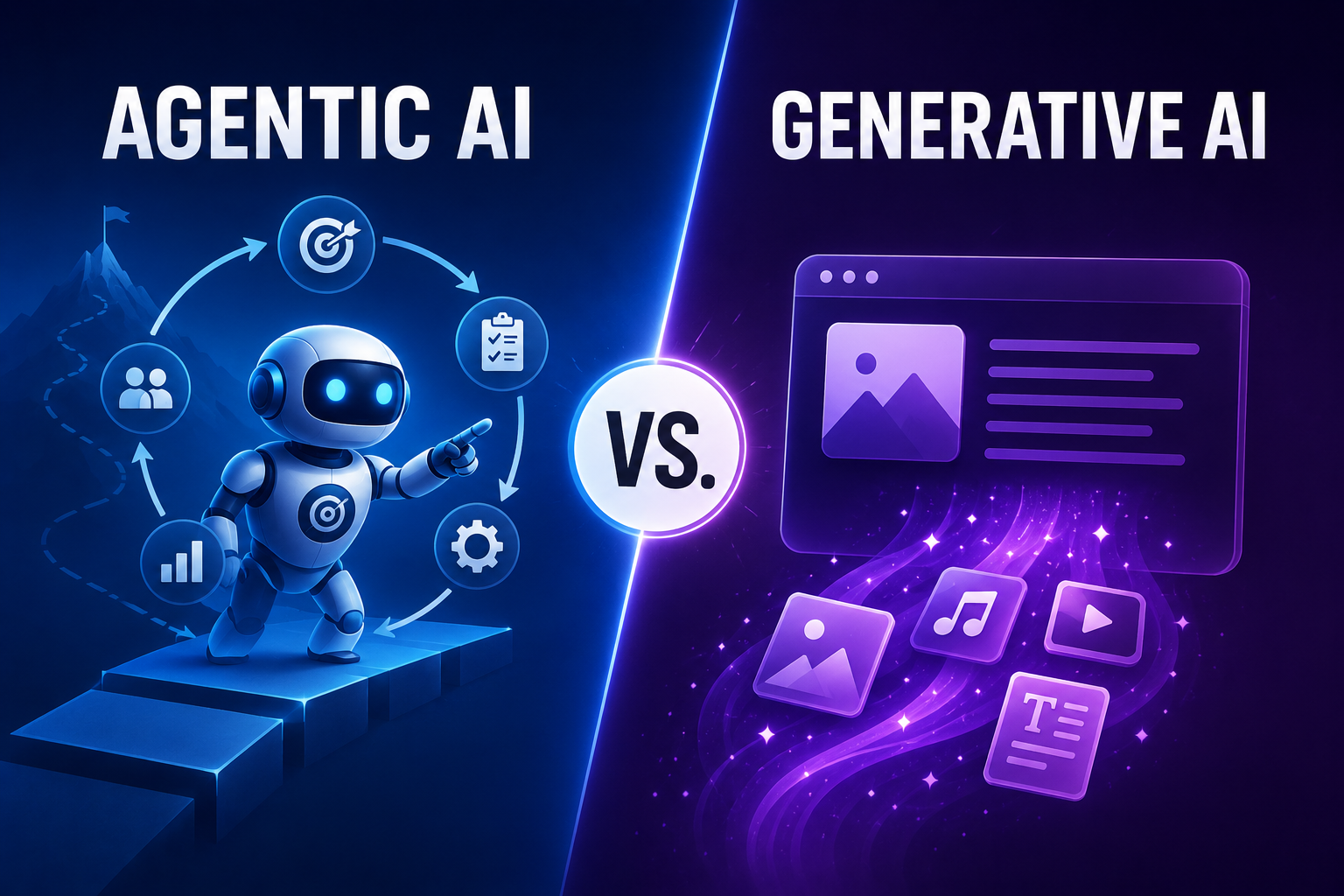
Agentic AI vs. Generative AI: What's the Real Difference?
Generative AI and agentic AI can look similar because both may use large language models. The difference is what happens after you give the instruction. Generative AI creates an output: a draft, summary, image, code snippet, email, or idea. Agentic AI can work toward a goal, choose the next step, use tools, and keep moving.
That distinction matters when you choose what to build or use. If you need a quick answer or creative draft, generative AI is usually enough. If you need follow-through across tools, files, apps, or recurring work, you are moving into agentic AI.
Quick Answer: Agentic AI vs Generative AI
The short version: generative AI creates outputs; agentic AI completes goals.
For the AI agent vs. generative AI distinction, use this example: generative AI can write a follow-up email. An AI agent can review the customer record, draft the email, update the CRM, create a reminder, and ask you to approve the send.
| Category | Generative AI | Agentic AI |
|---|---|---|
| Main job | Creates content | Completes goals |
| Input | Prompt | Goal or instruction |
| Output | Text, image, code, media, summary | Actions, decisions, workflow progress |
| Autonomy | Low to moderate | Higher |
| Tool use | Optional | Central |
| Best for | Drafting, summarizing, ideation | Research, automation, monitoring, execution |
| Main risk | Inaccurate content | Wrong action, unsafe access, or workflow failure |
That is the core of generative AI vs. agentic AI. One gives you something to review. The other can help move the work forward.
What Generative AI Does Well
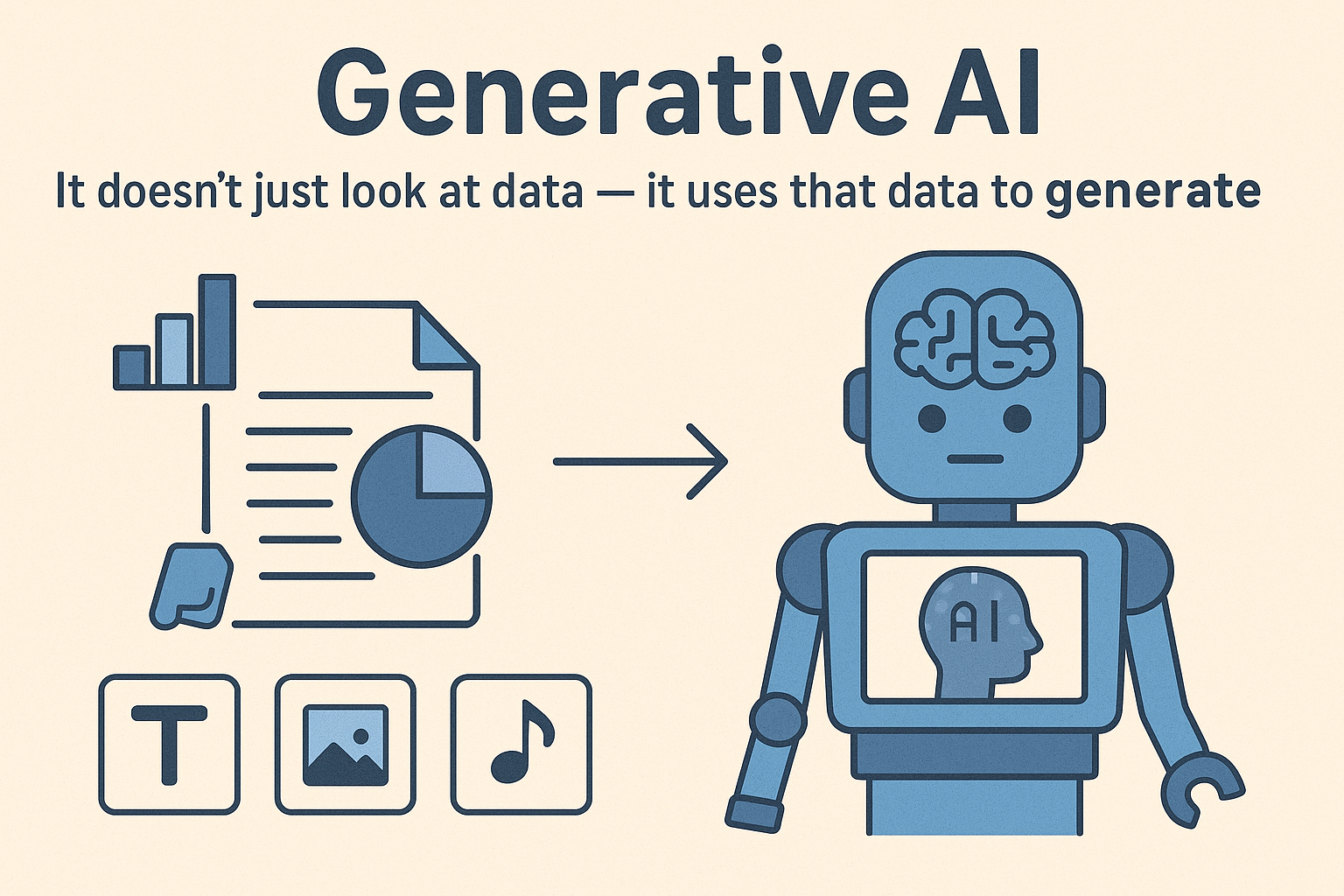 Generative AI is strongest when the task ends with a useful output. You give it context, examples, a prompt, or a file, and it generates something you can use or edit.
Common generative AI examples include:
- writing emails, briefs, ads, and product descriptions
- summarizing meetings, articles, or documents
- generating image and video prompts
- creating code snippets or SQL queries
- rewriting documentation
- brainstorming campaign ideas
You stay in control: ask for a result, check it, and decide what to do next. For creative, low-risk, or one-off work, that is often the cleanest setup.
What Agentic AI Adds
 Agentic AI adds planning, tool use, memory, and action. Instead of stopping at a generated answer, it can continue toward a goal. A useful agent can inspect information, choose a next step, use a browser or API, write files, update records, and report progress.
The traits that make AI agentic are:
- goal orientation
- multi-step planning
- access to tools
- memory or working state
- feedback loops
- action across apps, files, browsers, APIs, or messages
This is where agentic AI examples feel different from normal prompt use. You might ask an agent to research a company, summarize buying signals, draft a follow-up, and prepare a CRM update. You might also ask it to monitor an inbox or inspect a repo and run tests.
If you are comparing fixed automation with agent work, the difference is similar to OpenClaw vs. n8n: fixed workflows work best when every step is known in advance, while agents help when the task needs judgment.
Agentic AI vs. Generative AI: 5 Key Differences
The agentic AI vs. generative AI difference becomes clearer when you compare how each system behaves in real work.
1. Prompt Response vs. Goal Completion: Generative AI responds to what you ask. Agentic AI starts from what you want done.
2. Content Output vs. Real-World Action: Generative AI gives you content. Agentic AI may use that content, then save a file, update a task, call an API, or prepare an approval.
3. Single-Step Help vs. Multi-Step Execution: Generative AI helps with one part of the job. Agentic AI carries context across steps until the workflow reaches a useful checkpoint.
4. Lower Operational Risk vs. Higher Operational Risk: Generative AI risk usually lives in the output. Agentic AI risk can affect tools, data, credentials, files, or messages, so permissions and approvals matter more.
5. Human-in-the-Loop vs. Human-on-the-Loop: With generative AI, you guide each step. With agentic AI, you define the goal, boundaries, and approvals, then supervise.
Same Task, Different Results
The simplest way to understand agentic vs. generative AI is to compare the same task.
For sales follow-up, generative AI writes the email. Agentic AI can check the lead, review recent messages, draft the email, update the CRM, and create a reminder. If sales is your main workflow, tools to automate sales workflow shows how AI assistants and automation tools fit into the larger stack.
For a weekly SEO report, generative AI summarizes exported data. Agentic AI can collect the inputs, compare pages, check ranking changes, draft insights, and prepare the report on schedule.
For developer work, generative AI explains an error or writes a snippet. Agentic AI can inspect files, run commands, edit code, test the change, and explain what it changed.
When Generative AI Is Enough
You do not need an agent for every task. In many cases, generative AI is simpler, safer, and faster.
Use generative AI when:
- the task is one-off
- the output is the deliverable
- no external tools are needed
- you will review and apply the result manually
- the work is creative, exploratory, or low-risk
For many generative vs agentic AI decisions, ask one question: do you need an answer, or do you need a process? If you only need a draft, summary, idea, or explanation, keep it simple.
When You Need Agentic AI Instead
Agentic AI becomes useful when the work starts after the first answer. You need more than a model response when the task crosses tools, depends on changing context, or repeats over time.
You probably need agentic AI when:
- the task has several steps
- the system needs tool access
- the same workflow repeats often
- the output depends on changing context
- the assistant needs memory or state
- you want monitoring, reporting, triage, or follow-through
This is where AI agent workflow automation becomes more useful than normal trigger-action automation. A fixed automation moves data from one app to another. An agent workflow can interpret messy input before deciding what should happen next. For the broader category, see workflow automation software.
The Real Shift: From Prompts to Agent Workflows
The real shift is from one-off prompts to repeatable systems.
A prompt helps once. A reusable instruction can become a skill. A skill connected to tools, files, memory, and schedules becomes an agentic AI workflow. You stop asking AI to help with isolated steps and start designing repeatable work.
For example, a coding prompt might explain an error once. A coding skill can define how to inspect a repo, run tests, edit files, and summarize changes every time. If technical workflows matter to you, compare the options in best AI agent for coding.
The same pattern applies to marketing, research, operations, and support. The value is not only better answers. It is reusable execution.
How to Run an Always-On AI Agent
Once you decide you need an agent, the next question is practical: where does it run?
You can run an agent locally if you are experimenting. That is simple, but your laptop can sleep, disconnect, or restart.
You can self-host on a VPS if you want more control. That gives you better uptime, but you also own setup, Docker, security, logs, backups, updates, and troubleshooting. For that path, start with best VPS for OpenClaw.
 You can also use managed OpenClaw hosting. If you want a private, always-on OpenClaw environment without maintaining the server layer yourself, MyClaw gives you a managed instance with 24/7 availability, encrypted access, automatic updates, and less infrastructure work.
How to Choose Between Generative AI and Agentic AI
Choose generative AI if you need content, summaries, ideas, images, or code snippets. It is faster, easier to control, and usually safer when a human will apply the result manually.
Choose agentic AI if the task spans several steps, tools, or systems. It is a better fit when you need context, memory, scheduled work, workflow execution, or follow-through.
Use both when the workflow has two layers. Generative AI can draft, summarize, classify, or explain. The agentic layer can decide what to do with that output and move the process forward. That is the practical agentic vs generative AI answer: they often work at different layers of the same system.
FAQ
Is ChatGPT Agentic AI or Generative AI?
ChatGPT is primarily generative AI, but tool-enabled modes can behave more like agentic AI. The category depends on whether it only answers or can plan, use tools, and act across steps.
Is Agentic AI Better Than Generative AI?
Not always. Agentic AI is better for multi-step execution, but generative AI is simpler and often better for one-off content tasks.
Does Agentic AI Use Generative AI?
Yes. Generative AI often provides reasoning, drafting, summarization, and analysis inside an agentic system.
What Is the Difference Between Agentic AI and an AI Agent?
Agentic AI describes the approach: goal-driven, tool-using, semi-autonomous AI. An AI agent is the specific assistant or system built with that approach.
What Is the Main Risk of Agentic AI?
The risk shifts from flawed output to harmful action. Permissions, approvals, logs, and isolation matter more when an agent can touch tools or data.
Conclusion
The agentic AI vs. generative AI difference is really about output versus execution. Generative AI helps you create useful content from prompts. Agentic AI helps you turn goals into workflows that can use tools, remember context, and act with supervision.
If you only need a draft, idea, summary, or explanation, generative AI is enough. If you need recurring work, tool access, memory, and a private always-on agent, agentic AI is the better direction. Once you reach that point, the practical question becomes where the agent runs. MyClaw is one managed OpenClaw option for using agent workflows without taking on the full infrastructure burden yourself.
설정을 건너뛰세요. 지금 OpenClaw를 실행하세요.
MyClaw는 완전 관리형 OpenClaw(Clawdbot) 인스턴스를 제공합니다 — 항상 온라인, DevOps 제로. $19/월부터.