Best Brand Tracking Tools in 2026: What to Track and Automate
Your brand is no longer judged in one place. A buyer might find you on Google, compare you on Reddit, read reviews, ask ChatGPT for alternatives, and only then visit your site. The right brand tracking tools help you see where your brand appears, how it is described, who you are compared with, and what deserves action.
The key is knowing what you want to track, which channels shape buying decisions, and how your team will act on the data.
What Brand Tracking Tools Should Help You See
Brand tracking starts with visibility and trust. Do buyers recognize your name, remember it without being prompted, and consider you against competitors? Survey-based tools help answer those long-term brand health questions.
You also need to watch public conversation. Social listening and brand monitoring tools show mentions, sentiment shifts, campaign reactions, competitor comparisons, and reputation risks across social media, reviews, news, forums, and communities. If social channels are a major brand surface, this guide to social media automation is useful for turning monitoring into a repeatable workflow.
The newest layer is search and AI visibility. AI brand visibility tracking tools help you see whether AI systems mention your brand, which competitors appear instead, what sources get cited, and whether your product is described accurately.
The Main Types of Brand Tracking Tools
Most tools fit into four groups: survey-based tracking, social listening, SEO and web visibility, and AI visibility. Here is how common products usually fit:
Brand Tracking Tools and AI Brand Visibility Tracking Tools Compared
| Product | Category | Use it when you need |
|---|---|---|
| YouGov BrandIndex | Survey-based brand tracking | Continuous brand health, awareness, consideration, and competitor benchmarks |
| quantilope | Automated consumer research | Faster survey waves, concept tests, and recurring brand tracking studies |
| Brandwatch | Social listening and consumer intelligence | Deep social data, audience analysis, sentiment, and conversation trends |
| Meltwater | Media monitoring, social listening, and AI visibility | PR monitoring, news coverage, social signals, and AI-generated answer tracking |
| Brand24 | Brand monitoring | Mention tracking, alerts, sentiment, and smaller-team social monitoring |
| Ahrefs Brand Radar | SEO, web visibility, and AI visibility | Search visibility, brand mentions, competitor content, and AI answer visibility |
| Semrush AI Visibility Toolkit | SEO and AI visibility | AI visibility checks alongside keyword, content, and competitor SEO data |
| Profound | AI search visibility | Tracking how AI systems mention, cite, and compare your brand |
| MyClaw | AI agent workflow layer | Automating recurring brand checks, competitor monitoring, AI visibility reviews, and weekly reports |
These products are not interchangeable. YouGov will not replace social listening. Brandwatch will not measure survey-based purchase intent. An AI visibility platform will not tell you everything about brand health. MyClaw is different too: it is not the source database for brand tracking; it helps run the recurring workflow around those tools. The best AI brand visibility tracking tools show prompts, competitors, citations, and AI answer patterns. If you only choose one AI brand visibility tracking tool, make sure it tracks the prompts and sources that influence your buyers. For the system behind recurring AI workflows, MyClaw's guide to choosing an AI agent platform gives useful context.
How to Choose the Right Brand Tracking Tool
Start with the question you need answered:
- Use survey-based tracking if you need to measure awareness, trust, and consideration.
- Use social listening if you need to monitor discussion, sentiment, and emerging topics.
- Use SEO tools if you need to track rankings, competitor pages, and content gaps.
- Use AI visibility tools if you need to know whether ChatGPT, Perplexity, Gemini, or Google AI Overviews mention your brand.
How to Choose an AI Brand Visibility Tracking Tool
If AI search influences your category, look for prompt tracking, competitor comparisons, citation sources, model coverage, and historical reporting. A simple mention check is not enough; you need to know why your brand appears, where competitors win, and which sources AI systems trust.
 The data source matters more than the interface. A survey panel, a social index, a backlink database, and an AI prompt database are not interchangeable. Before comparing pricing, check where the data comes from, how often it updates, and whether competitor benchmarks are included.
Competitor tracking should be a default requirement. Brand tracking is much more useful when you can see whether your share of voice is rising, whether competitors are cited more often, and whether the category narrative helps or hurts you.
Where Brand Tracking Tools Break Down
Most brand tracking tools are good at showing signals. They are weaker at helping you follow through.
A dashboard may show that a competitor appears in more AI answers, your pricing page is criticized in a forum, or a review site outranks your product page. Each signal matters, but someone still has to interpret it, collect evidence, and create the next task.
AI visibility makes this harder because one check is not enough. Answers can shift by prompt wording, model, retrieval source, location, and timing. You need repeated checks to tell whether visibility is changing or you are looking at noise. This is where agentic work matters: a text model can summarize once; an agent can keep checking and compare changes over time. This guide to agentic AI vs generative AI explains that difference in more detail.
The real workflow is simple, but easy to neglect:
- Find the change.
- Decide whether it matters.
- Collect the evidence.
- Create the task.
- Alert the right person.
- Check again next week.
That is not only a measurement problem. It is a workflow problem. If you are comparing broader automation options, this guide to workflow automation software can help you separate simple trigger-based automation from AI-assisted workflows.
A Practical Brand Tracking Workflow for Small Teams
You can start with a lightweight weekly workflow before buying a large brand intelligence stack.
First, define the surfaces that matter. For a SaaS team, that might include Google results, comparison pages, Reddit threads, review sites, competitor pages, and AI answers. For a consumer brand, it may include social platforms, reviews, news, retail search, and AI recommendations.
Second, choose a small set of prompts and queries to repeat. Do not test random questions every week. Use the same prompts so you can compare changes:
- "Best tools for [
category]" - "[
Brand] alternatives" - "[
Brand] vs [competitor]" - "Best [
category] software for small teams" - "What should I use for [
specific use case]?"
Third, turn findings into a short report.
| Section | What to include |
|---|---|
| What changed | New mentions, lost visibility, competitor movement, sentiment shifts |
| Why it matters | Impact on discovery, trust, conversion, or positioning |
| Evidence | URLs, screenshots, citations, prompt outputs |
| Recommended action | Update a page, answer a comparison, join a discussion, fix messaging |
| Owner | The person or team responsible for follow-up |
This can stay manual at first. Once it becomes repetitive, you can automate parts of it. If you already use automation builders or are comparing fixed workflows with agent workflows, the OpenClaw vs n8n comparison is a useful way to think about the tradeoff.
When to Add an AI Agent to Brand Tracking
An AI agent makes sense when your brand tracking process has repeatable checks but still needs judgment. It is useful when the task involves reading pages, comparing outputs, summarizing evidence, and deciding whether something deserves attention.
What MyClaw Is
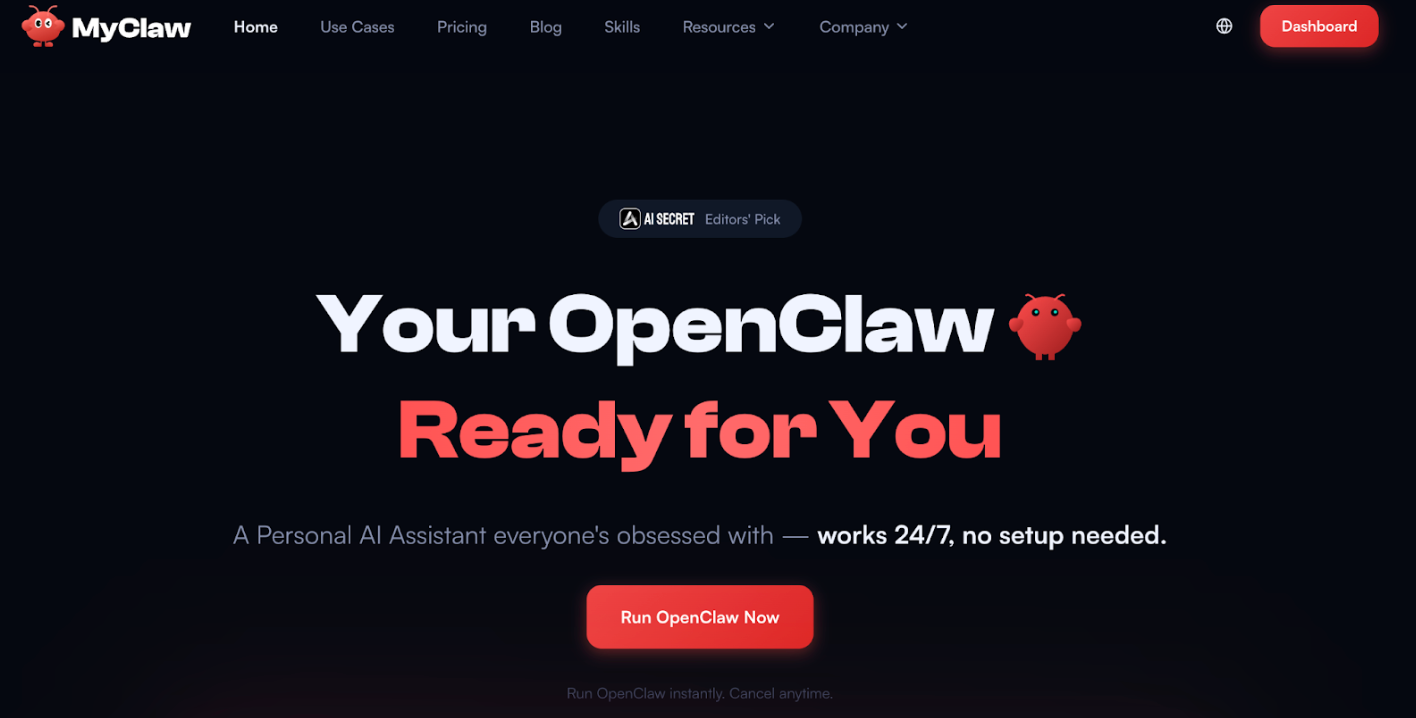 MyClaw is managed cloud hosting for OpenClaw, an open-source AI assistant that can work across apps, browsers, files, messages, and connected tools. Instead of setting up servers, dependencies, updates, and backups yourself, you get a private OpenClaw instance that stays online and ready to work.
That matters if you want an AI assistant to do more than answer a one-off question. For brand tracking, the useful part is persistence: your agent can keep checking the same sources and prepare a structured summary without you rebuilding the process every week.
How MyClaw Fits Into Brand Tracking
MyClaw should not be treated as a replacement for specialist data platforms. You may still use a survey tracker for brand health, a social listening tool for public conversation, an SEO tool for rankings, and an AI visibility platform for prompt-level measurement. MyClaw is more useful around those tools.
You can use an OpenClaw agent running on MyClaw to help with recurring work:
- Check competitor pages and product updates.
- Review branded search results.
- Test AI recommendation prompts.
- Summarize visibility changes.
- Prepare a weekly brand tracking report.
- Send updates into Slack, Discord, Notion, email, or another team tool.
The value is consistency. If a task needs to happen every week, it should not depend on someone remembering to open five tabs and copy notes.
Best Brand Tracking Stack by Team Type
For brand and research teams, start with survey-based brand tracking and add social listening.
For SEO and content teams, combine an SEO platform with AI visibility tracking. You want to know which pages rank, which competitors are cited, and whether AI systems recommend your brand.
For founders and lean teams, start smaller. Pick one SEO or monitoring tool, define a simple AI visibility check process, and write a weekly report. Add MyClaw when the manual work becomes too repetitive or too easy to forget.
The best setup is not the one with the most dashboards. It is the one your team can actually use every week.
Conclusion
The best brand tracking tools help you understand awareness, sentiment, search visibility, competitor position, and AI visibility. But measurement is only half of the work. You also need a way to turn signals into decisions.
Use specialist tools for the data they collect best. Then add automation when the work becomes repetitive. For teams that already know what they need to monitor, MyClaw can help keep a private OpenClaw agent running so recurring brand checks, AI visibility reviews, and weekly reporting do not depend on manual follow-through every time.
Évitez la configuration. Lancez OpenClaw maintenant.
MyClaw vous offre une instance OpenClaw (Clawdbot) entièrement gérée — toujours en ligne, zéro DevOps. Plans à partir de 19$/mois.