Amazon Lightsail Now Runs OpenClaw — How Does It Compare to MyClaw?
Amazon just launched one-click OpenClaw deployment on Lightsail, making it the first major cloud provider to offer a dedicated OpenClaw blueprint. But if you are choosing between Lightsail and a fully managed platform like MyClaw.ai, the differences go far beyond the deploy button. Here is an honest breakdown of what each option gives you and where each falls short.
What AWS Lightsail for OpenClaw Actually Offers
Amazon Lightsail now includes OpenClaw as a selectable blueprint — the same way you would spin up a WordPress or Node.js instance. Choose your region, pick the OpenClaw blueprint, select a plan (AWS recommends the 4 GB memory tier), and your instance is running in a few minutes.
The setup is pre-configured with Amazon Bedrock as the default AI model provider. Once the instance is live, you connect via browser-based SSH, pair your browser with a security token, enable Bedrock API access through a CloudShell script, and you are chatting with your OpenClaw agent.
It is a significant improvement over raw EC2 deployment, which required manual Docker setup, security configuration, and networking. AWS themselves acknowledged that installing OpenClaw "is not easy and that there are many security considerations."
But "easier than EC2" and "easy" are not the same thing.
The Setup Gap
Here is what the Lightsail setup still requires you to do:
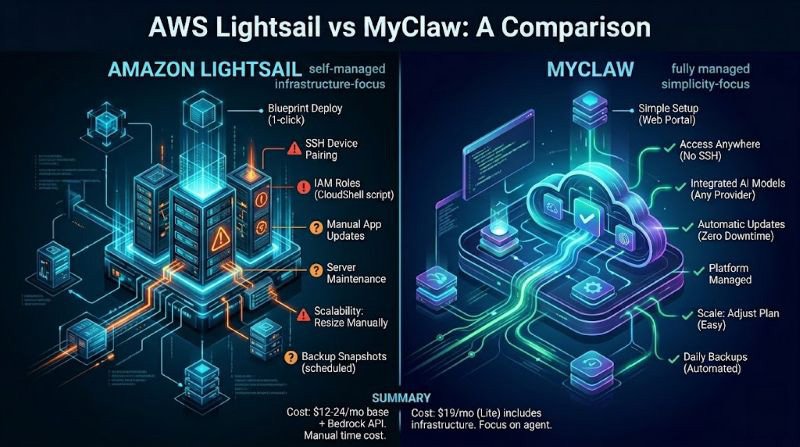
Browser pairing via SSH. You need to open an SSH terminal, copy security credentials from the welcome message, paste them into the OpenClaw dashboard, then approve the device pairing in the terminal. This is straightforward for developers but confusing for non-technical users.
Bedrock API activation. AI capabilities do not work out of the box. You need to copy a script from the Getting Started tab, open AWS CloudShell, run it, and wait for IAM role creation. If you want models beyond the default Bedrock selection, you need to modify IAM policies manually.
Messaging channel setup. Connecting Telegram, WhatsApp, or Discord requires additional configuration steps documented separately. Each channel has its own setup flow involving bot tokens, QR code scanning, or OAuth — and if something breaks, you are debugging it through SSH.
Ongoing maintenance. You are responsible for OpenClaw updates, security patches, backups, and monitoring. Lightsail gives you the server — keeping it healthy is on you. When OpenClaw pushes a major update (which happens frequently in this fast-moving project), you need to SSH in, pull the update, handle any breaking changes, and restart services.
Scaling and performance tuning. If your OpenClaw agent starts hitting memory limits or CPU bottlenecks, you need to resize the Lightsail instance yourself, migrate data, and reconfigure. Downtime during migration is your responsibility to manage.
With MyClaw, the entire setup is: create an account, pick a plan, done. No SSH, no IAM roles, no scripts. Your OpenClaw instance is running and accessible from any device within minutes, with messaging channels configurable through the chat interface itself.
Cost Comparison
Both platforms offer predictable monthly pricing, but the total cost of ownership differs:
Lightsail pricing starts at $12/month for the 2 GB plan, with AWS recommending the $24/month 4 GB plan for optimal OpenClaw performance. You also pay for Bedrock API usage separately — token costs for Claude, Llama, or other models are billed per request on top of the instance price.
MyClaw pricing starts at $19/month for the 4 GB plan (Lite plan) and includes the fully managed instance. AI model costs (API tokens) are separate on both platforms, so the real comparison is infrastructure cost plus your time.
The hidden cost with Lightsail is maintenance time. Every hour you spend debugging an update, configuring security groups, or recovering from a failed backup is time not spent using your OpenClaw agent. For a one-person company running on OpenClaw, that time cost compounds quickly.
Feature Comparison
Model flexibility. Lightsail defaults to Amazon Bedrock, which gives you access to Claude, Llama, Mistral, and other models in the Bedrock ecosystem. MyClaw supports any model provider — Anthropic directly, OpenAI, Google, local models — without being locked into one ecosystem.
Updates and patches. On Lightsail, you manage updates yourself. On MyClaw, updates are automatic and zero-downtime.
Backups. Lightsail offers snapshots (manual or scheduled, with additional storage costs). MyClaw includes automated daily backups in every plan.
Multi-device access. MyClaw instances are accessible from any device through the web dashboard or messaging apps. Lightsail requires browser pairing per device, and mobile access depends on your messaging channel configuration.
Security. Both offer network isolation. Lightsail gives you fine-grained IAM control (powerful but complex). MyClaw handles security hardening as part of the managed service.
Who Should Choose Which
Choose Lightsail if:
- You want full control over your infrastructure and IAM permissions
- You are already in the AWS ecosystem with Bedrock credits or enterprise agreements
- You have the technical skills and time to manage a server
- You need specific AWS region placement for compliance or latency
Choose MyClaw if:
- You want OpenClaw running in minutes with zero server management
- You are not a developer or do not want to maintain infrastructure
- You value automatic updates, backups, and monitoring
- You want to optimize your token costs without worrying about the underlying platform
What AWS Entering Means for the Ecosystem
The bigger story here is validation. When AWS builds a dedicated blueprint for an open-source project, it signals serious enterprise demand. OpenClaw is not a niche tool anymore — it is infrastructure-grade software that Fortune 500 companies want to deploy.
This is good for everyone in the ecosystem. More users means more skills on ClawHub, more integrations, more community support, and faster development. Whether you run OpenClaw on Lightsail, MyClaw, or your own hardware, the ecosystem grows when new players enter.
The question for most users is not "which cloud provider" — it is "do I want to manage a server or just use OpenClaw?" If your answer is the latter, that is exactly what managed hosting exists for.
Frequently Asked Questions
Is Amazon Lightsail for OpenClaw free?
No. Lightsail plans start at $12/month for 2 GB RAM, with the recommended 4 GB plan at $24/month. Bedrock AI model usage is billed separately based on token consumption. There is a free trial period for new Lightsail users.
Can I switch from Lightsail to MyClaw (or vice versa)?
Yes. OpenClaw stores its configuration and memory in standard files that can be exported and imported. You can migrate your agent's memory, skills, and settings between any OpenClaw hosting environment.
Does Lightsail support all OpenClaw features?
Yes, it runs the full open-source OpenClaw software. However, features like messaging channels require manual configuration, and model access depends on what is available through Amazon Bedrock in your region.
Is MyClaw more expensive than self-hosting on Lightsail?
The base price is similar ($19/mo vs $24/mo for comparable specs). The difference is that MyClaw includes management, updates, backups, and support — services you would otherwise handle yourself on Lightsail. For users who value their time, managed hosting is typically cheaper in total cost of ownership.
Can I use non-AWS models on Lightsail OpenClaw?
Yes, but it requires manual configuration. The default Bedrock setup provides Claude, Llama, and other Bedrock models. To use OpenAI, Google, or other providers, you need to configure API keys and model settings yourself through the OpenClaw interface.
Skip the setup. Get OpenClaw running now.
MyClaw gives you a fully managed OpenClaw (Clawdbot) instance — always online, zero DevOps. Plans from $19/mo.