How One Founder Uses OpenClaw + Discord to Run His Entire Company
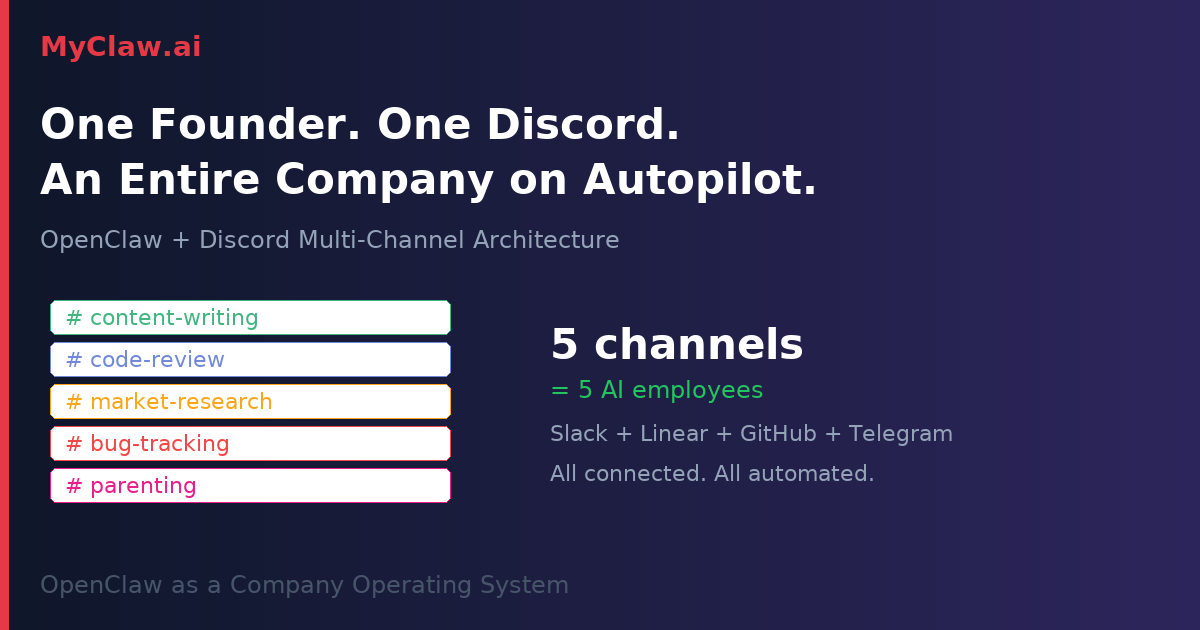
A founder in Taiwan shared something on X that stopped me in my tracks. He's running his entire company through Discord channels — each one powered by OpenClaw with different system prompts and skills. Writing, coding, market research, bug tracking, even parenting advice. All automated, all in one place.
His post hit 24K views and 321 likes. But the real value isn't the numbers — it's the architecture.
The Setup: One Discord Server, Multiple AI Employees
Here's how it works. Each Discord channel gets its own personality:
📝 Content Channel — System prompt tuned for writing, loaded with brand guidelines and style docs
💻 Code Channel — Coding-focused prompt with repo context and technical skills
📊 Research Channel — Market analysis prompt with competitor data and industry feeds
👶 Parenting Channel — Knowledge base built from curated international parenting blogs
Each channel has its own system prompt, its own skills, and its own memory. Complex projects get dedicated project folders and custom memory stores injected into the prompt — cutting unnecessary tool calls and saving tokens.
Think of it as hiring a team of specialists, except they cost $30/month total and never sleep.
The Integrations That Make It Real
This isn't a toy setup. He connected:
💬 Slack — Company communications
📋 Linear — Project management and ticket tracking
🐙 GitHub — Code repositories
📱 Telegram — Customer community group
OpenClaw scans the Telegram community chat automatically. When someone reports a bug or requests a feature, the AI judges severity and opens a Linear ticket assigned to the right person — no human in the loop.
Weekly meeting recordings go through Whisper for transcription, then OpenClaw generates meeting summaries and action items. Every week. Automatically.
The Moment AI Starts Thinking for Itself
Here's where it gets interesting. He didn't program any of this next part.
After accumulating enough context — meeting decisions, ticket assignments, project timelines — the AI started doing things he never designed:
When a task exceeded its expected timeline, OpenClaw proactively suggested he have the PM follow up on the delay.
No rule triggered this. No automation was set up. The AI simply had enough context to connect the dots: this task is late → this person is responsible → someone should follow up.
This is what "context engineering" actually means in practice. The more structured information you feed in, the more emergent behaviors you get out. Behaviors you couldn't have predicted or designed in advance.
The Unexpected Use Case: Parenting
With a newborn at home, he needed reliable parenting information. But most content in Chinese-language sources was low-quality and recycled.
So he built a solution:
- OpenClaw crawled high-quality international parenting blogs
- NotebookLM Skill structured and summarized the content
- Everything went into a dedicated Knowledge Base
- Now he asks parenting questions in a Discord channel backed by vetted sources
No hallucinations. No recycled advice. Just answers grounded in sources he personally curated.
The Insight Most People Miss
None of these use cases were planned before installation. Every single one emerged from hitting a real problem and thinking: "Wait, maybe OpenClaw can handle this."
As he put it:
"Most people think: figure out what you need first, then decide whether to install. But that logic has a fatal flaw — you can't know what it can do until you use it."
The killer use cases aren't in tutorials or documentation. They're personal. They only emerge when you're actually using the tool and stumble into a pain point.
The Growing Gap
Every month you wait, the gap widens. Not in knowledge — in mental models.
People who use AI agents daily think differently. When they see a task, their brain automatically maps a path: "This could be automated." That pattern recognition only develops through hands-on experience. You can't learn it from screenshots and tweets.
Six months ago everyone was sharing prompt templates. Then it was MCP. Now it's Skills. The landscape shifts every few months. Without heavy usage, you can't even understand why people are moving from one paradigm to the next.
Build This Yourself — Or Don't
Replicating this setup requires:
⚙️ A VPS or server running OpenClaw
🔗 Discord bot configuration with multiple channels
🔑 API keys for your AI model of choice
🛠️ Integration setup for Slack, Linear, GitHub, Telegram
⏱️ Hours of prompt engineering and testing
Or you skip all of that with MyClaw.ai. Managed OpenClaw, pre-configured, ready to connect to your Discord in minutes. Same architecture, zero infrastructure headaches.
The Bottom Line
This founder didn't build a chatbot. He built a company operating system — one Discord server at a time. And the most powerful features weren't the ones he designed. They were the ones that emerged after he fed the AI enough context to start connecting dots on its own.
The question isn't what OpenClaw can do. It's what it'll figure out once you give it enough context about your world.
Skip the setup. Get OpenClaw running now.
MyClaw gives you a fully managed OpenClaw (Clawdbot) instance — always online, zero DevOps. Plans from $19/mo.