OpenClaw's Peter Steinberger Calls Out Tencent for Mirroring ClawHub Without Permission or Support
Peter Steinberger learned about Tencent's SkillHub the way most people learn about copycats — from a stranger on X. Not from a partnership proposal. Not from a licensing email. From a tweet.
On March 12, X user SnowShadow (@Alfredxia) asked Steinberger directly: "Do you know that Tencent created a SkillHub, which scraped all the skills from ClawHub and imported them into its own platform?"
Steinberger's response was blunt:
"Kinda... I got an email once from folks complaining that my rate limits block them from scraping fast enough. They copy yet they don't support the project in any way. 😞"
That single exchange — 1,175 likes, 87k+ views — ignited one of the biggest debates the OpenClaw ecosystem has seen: when a trillion-dollar corporation mirrors an open-source project's entire skill marketplace without permission, funding, or even a heads-up, who's really building the ecosystem and who's extracting from it?
What Tencent Actually Did
Tencent launched SkillHub, a platform that imported all 5,000+ skills from ClawHub — the MIT-licensed skill directory for OpenClaw — and repackaged them as a "localized mirror" for Chinese users.
The numbers Tencent shared in their public response:
📊 First week: 180GB of traffic served to users (870,000 downloads)
📊 Data pulled from ClawHub: only 1GB
📊 Method: "non-concurrent requests" from the official source
On paper, this looks efficient. In practice, Steinberger tells a different story: ClawHub's server costs were approaching five figures, driven in part by automated scraping from large organizations — and Tencent never contributed a cent.
Peter's Public Callout
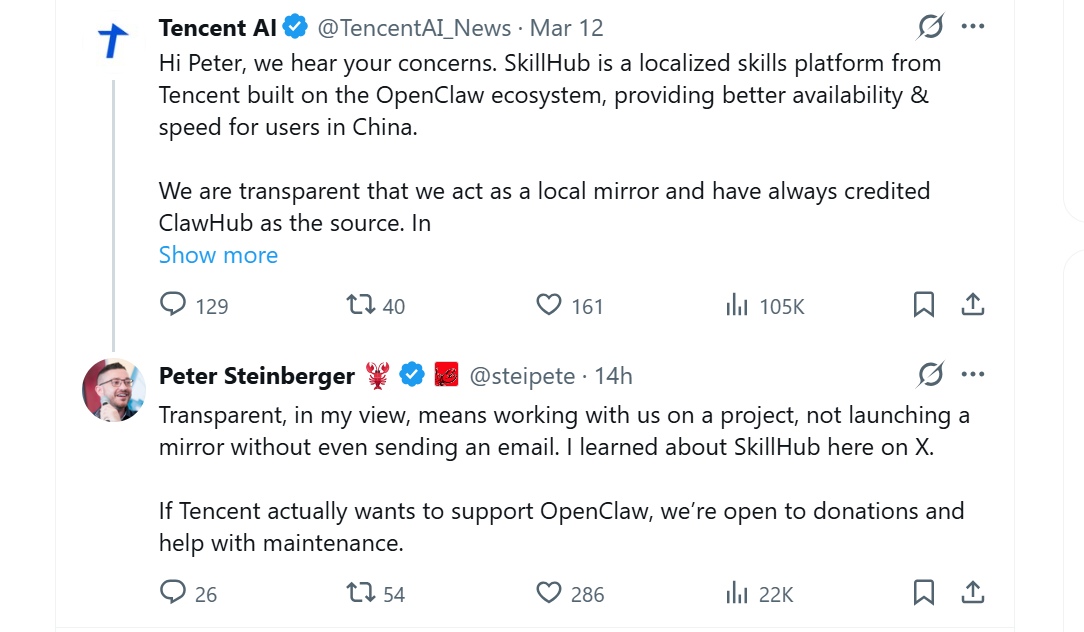
When Tencent AI's official X account (@TencentAI_News) responded with a diplomatic statement — "We are transparent that we act as a local mirror and have always credited ClawHub as the source" — Steinberger wasn't having it:
"Transparent, in my view, means working with us on a project, not launching a mirror without even sending an email. I learned about SkillHub here on X. If Tencent actually wants to support OpenClaw, we're open to donations and help with maintenance."
The community response was overwhelmingly on Peter's side:
🗣️ @hkdom (65♥): "Can you do some real sponsorship instead of just saying this?"
🗣️ @miantiao (19♥): "腾讯云直接赞助服务器就完事了" (Tencent Cloud should just sponsor the servers)
🗣️ @kylooong (7♥): "愿意撒以亿为基本单位的红包去拉DAU也不肯赞助一下人家5位数的服务器支出" (Willing to spend hundreds of millions on red packets for DAU but won't sponsor five-figure server costs)
🗣️ @CuriousCat1sj (14♥): "简中区抄袭剽窃习惯了,切到英文区没刹住车" (Used to copying in the Chinese internet, forgot to hit the brakes in English)
One user (@DnD_Priest) even challenged Tencent's "1GB pulled" claim: "Is data volume the same as bandwidth? If you downloaded 1GB of data, how much bandwidth did that consume? Tencent Cloud provides cloud services — we don't believe you can't distinguish between bandwidth and data volume."
The MIT License Paradox
Here's the uncomfortable truth: Tencent didn't break any rules. ClawHub's skills are MIT-licensed. Anyone can copy, redistribute, commercialize, and even close-source derivative work. Tencent is legally in the clear.
But legality and community trust are different things.
The MIT license was designed for a world where open source meant collaboration. When a company worth over $400 billion mirrors a solo maintainer's entire platform, contributes nothing financially, and then sends complaints about scraping rate limits — the spirit of open source takes a hit even if the letter of the license holds.
This tension isn't unique to OpenClaw. It's the same pattern that drove Redis, Elasticsearch, and MongoDB to abandon permissive licenses in favor of source-available models. The question for OpenClaw: does this incident push the project toward license changes, or does the community find another way to sustain itself?
What This Means for the OpenClaw Ecosystem
For skill developers: Your work on ClawHub is now simultaneously available on Tencent's SkillHub — without your explicit consent. If you published a skill expecting it to live on ClawHub, it now also lives on a Tencent-branded platform that you have no relationship with.
For Chinese users: SkillHub does solve a real problem. Accessing ClawHub from China can be slow, and a local CDN genuinely improves the experience. The question is whether Tencent should have built this relationship before building the platform.
For the project's sustainability: OpenClaw has 300,000+ GitHub stars, dozens of corporate users, and one overwhelmed creator whose server costs are spiraling. If Tencent — or any large company — can extract full value from the ecosystem without contributing, the project's long-term health is at risk.
The Bigger Picture: Who Pays for Open Source?
Peter Steinberger is building one of the most important open-source projects in AI — an agent framework that's reshaping how people interact with language models. He's doing this while personally absorbing infrastructure costs that are approaching enterprise-scale.
The Tencent incident is a symptom of a systemic problem: open-source maintainers create enormous value, corporations capture that value, and the financial burden stays with the creator.
MyClaw.ai — the #1 OpenClaw host — represents a model that actually works: users pay for 24/7 cloud hosting, one-click setup, version maintenance, and discounted frontier models (10% off Claude Opus 4.6, GPT-5.4, etc.). The ecosystem gets sustained by real revenue from people who use the best way to run OpenClaw — not by relying on the goodwill of trillion-dollar corporations.
It's not the only model, but it's a sustainable one. And it doesn't involve scraping someone's servers while complaining about rate limits.
What Happens Next
Steinberger left the door open: "If Tencent actually wants to support OpenClaw, we're open to donations and help with maintenance." The ball is in Tencent's court.
Whether they step up with real sponsorship — servers, engineering resources, financial contributions — or continue the "localized mirror" approach with nothing but PR responses will tell us everything about how seriously Chinese tech giants take open-source sustainability.
The community has spoken clearly. The question is whether Tencent is listening or just posting.
Skip the setup. Get OpenClaw running now.
MyClaw gives you a fully managed OpenClaw (Clawdbot) instance — always online, zero DevOps. Plans from $19/mo.